

Guidant Financial Group Blog


It is no secret that the Small Business Administration is not lending as much as it used to. It used to be that a decent percentage of our 401(k) Small Business Financing clients were securing our services in conjunction with an SBA loan. Over the last year, though, this has changed dramatically.

We hardly see people coming to us with the thought that an SBA loan will be a part of their financing package, and, even less do we see people who already have SBA financing in place.

This all may change, though, with new initiatives by the Obama Administration to broaden the Troubled Asset Relief Program. According to BusinessWeek.com (see Obama’s New Push to Help Small Business Get Loans) these initiatives will “lower the cost of capital for small banks and community development financial institutions that present plans to the Small Business Administration for increased small business lending through the SBA’s flagship 504 and 7(a) programs. It will also more than double the maximum size limit of some of its guaranteed loans to small business owners.”

This is all great news; however, we are wondering what, if anything, this will mean for lenders looking for smaller amounts. It used to be that we could refer clients to our lending partners to secure a loan of $75,000 - $100,000. Not anymore. Now all of our partners tell us that the SBA is practically refusing any requests for less than $250,000.

What about the true small business owner?

Fortunately, some thought has gone into these smaller loans. Microloans, which are popular for start-ups and struggling businesses, will see an increase in its maximum amount from $35,000 to $50,000.

Our hope is that this is a sign of things to come: more money for the prospective small business owner – and a jumpstart on the US economy.


We recently received a request to respond to a blog comment on Roth conversions within Guidant’s IRA/LLC structure. We thought this was a very good question to forward on to our general readership as well.

As of January 2010, Roth conversion requirements have been relaxed and the tax implications have been lessened. Because of this, many prospective and current clients are asking the question, “How can I convert to a Roth?”

If you are a prospective client, please call your existing administrator or Guidant to talk about your options. If you are an existing client, however, we are sure that you will find the information below very useful:

QUESTION: How does a Roth Conversion work with a Guidant IRA/LLC?

ANSWER: This is an excellent question, and one we receive often. If you currently have a Guidant IRA/LLC and wish to convert the traditional IRA component of that to a Roth IRA there are a few steps that will need to be taken.

The most important part of this process is the appraisal of any assets your IRA/LLC currently holds. It is extremely important to get an independent, written, third-party appraisal for any non-publicly traded assets, such as real estate. You should avoid any temptation to cut corners on this valuation – this is no time to try short cuts such as “windshield appraisals” by friendly realtors, etc. As this is the last opportunity the IRS has to collect taxes on this retirement account, they are going to be extra sure that they are collecting all owed taxes on this conversion.

The next part of this process is contacting your current IRA/LLC custodian to obtain their Roth conversion paperwork. This paperwork will create a new Roth IRA at your current custodian. In conjunction with filling out these documents, you should get in touch with Guidant to prepare a board resolution, by which the members of your LLC approve the conversion of the Traditional IRA to a Roth IRA. We will also provide you with further instructions on voiding current and creating new LLC members units certificates.

Once your custodian has accepted the new account paperwork, and Guidant has worked with you to complete the necessary changes to any LLC documents, your custodian will then complete the conversion by moving the assets (the units, as well as any cash in the account) to the Roth Conversion account. After this transfer is complete, the traditional IRA account is generally shut down.

We know that this sounds like a lot – but just as we provided you with all the assistance you needed to set up your IRA/LLC account to start, we will help walk you through this conversion process. Please feel free to contact us anytime!

Our IRA/LLC support team can be contacted directly at: 888.472.4455 x3311


If you’re looking to start your own business then you are likely aware that traditional sources of financing are difficult to obtain. Even if you’re like many of Guidant’s clients and have a stellar credit rating, you may not qualify under the tight credit policies of today’s lending institutions. At Guidant, we understand that small and medium-sized businesses are the cornerstone to a healthy economy. That’s why we strive to provide alternative small business investing solutions that assist our clients in achieving their dreams.

Finance Your Business with the Guidant 401(k) Plan


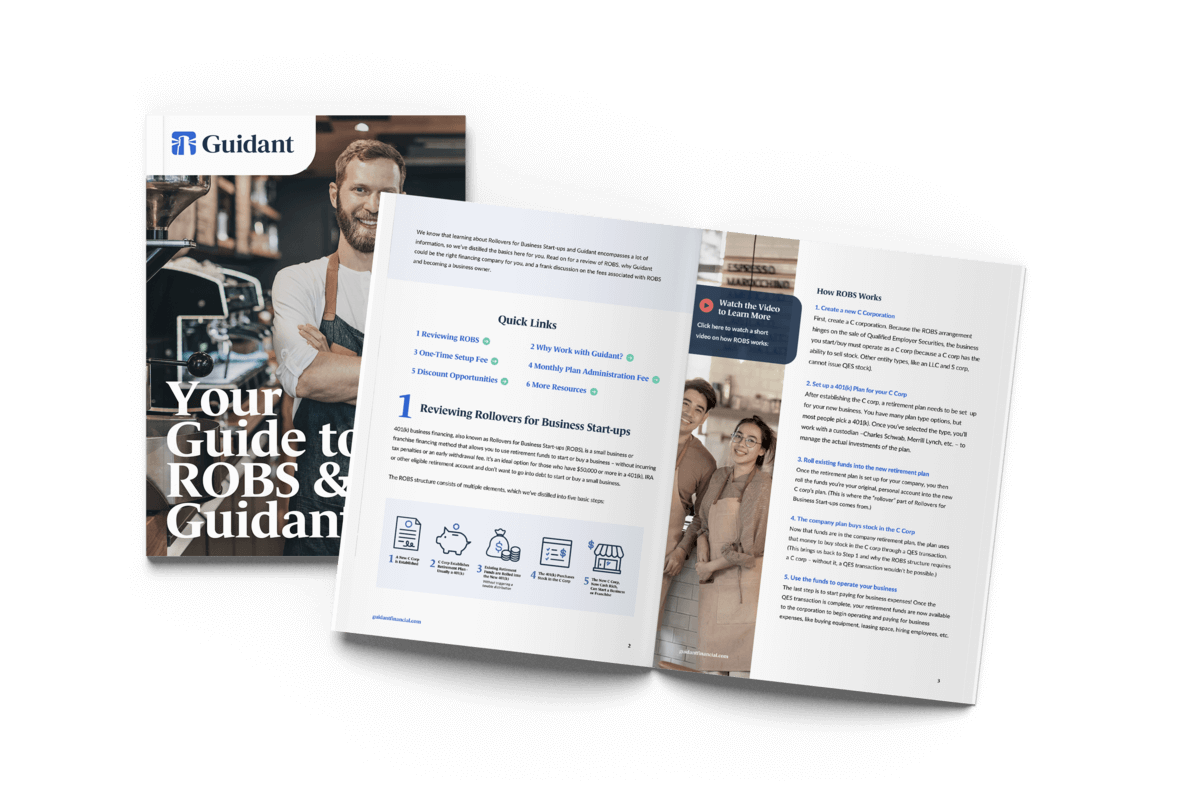
With the Guidant 401(k) Plan, you become your own financier by investing your retirement accounts into a business or franchise. As this is a self-directed investment and not an early withdrawal, there are no taxes or penalties applicable. And best of all, your new business will not have to pay the funds back as there is no debt. This opportunity can position your company for rapid growth in the early stages without using your earnings to make loan and interest payments.

At the same time, as your business flourishes and the value of the company rises so to does your retirement fund. That’s the beauty of the Guidant 401(k) Plan. If you have confidence in your abilities, unlike the loan officer at the bank, then this may be the solution to your entrepreneurial ambitions.


How the Guidant 401(k) Plan Works
• Guidant will assist you in setting up a C-Corp business organization for your new company or franchise.

• We will guide you through the process of setting up a 401(k) for your new business.

• Your retirement funds will be rolled over into the new Guidant 401(k) plan.

• The new 401(k) plan then purchases shares of the new corporation providing cash-flow to the business

• This small business financing option provides working capital for your new company without taxes, penalties, or debt.


Benefits of the 401(k) Alternative Small Business Financing Option
• Provides small business financing to start or purchase an existing business with the retirement savings you’ve already accrued.

• No bank managers or loan officers scrutinizing your every move.

• Puts your financial future entirely into your own hands. It’s not like the investment advisors have done a “bang up” job with handling your future.

• With no loan payments or interest expense, you’ll have lower overhead costs and increased cash flow. You’ll be able to invest those earnings into your business where you’ll get the most return on investment.

• Works in conjunction with SBA small business financing.

• Offers tax-deferred earnings within the plan

• You can continue to contribute your personal income into the 401(k) plan for additional retirement fund growth.


With the Guidant 401(k) Plan you get the better of two worlds. You invest your own hard-earned money into your new company and build the business and retirement fund at the same time. Guidant also offers alternative small business financing in the form of unsecured loans and equipment leasing as well. Your future is in your hands as it should be. Contact Guidant today to discuss alternative financing options for your business.


What is compliance?

The legal definition of compliance, according to Miriam-Webster’s Dictionary of Law, is:


Main Entry: com•pli•ance
Function: noun
1 : an act or process of complying with a demand or recommendation
2 : observance of official requirements

When industry professional s or Guidant employees refer to compliance issues with a self-directed IRA, most are referring to the restrictions put upon retirement plans and their investments, as directed by the Internal Revenue Code.

In general, compliance issues arise because a proposed investment is structured so that is in violation of IRC § 4975(c) (1), otherwise known as the “prohibited transaction codes.” These codes are a specific section of the Internal Revenue Code that dictate what a person cannot invest in, and who the IRA cannot invest with.

Per this code section, a prohibited transaction includes any direct or indirect:

• Selling, exchanging, or leasing any property between a plan and a disqualified person. For example, your IRA cannot buy property you currently own from you.

• Lending money or other extension of credit between a plan and a disqualified person. For example, you cannot personally guarantee a loan for a real estate purchase by your IRA.

• Furnishing goods, services, or facilities between a plan and a disqualified person. For example, you cannot use personal furniture to furnish your IRAs rental property.

• Transferring or using, by or for the benefit of, a disqualified person the income or assets of a plan. For example, your IRA cannot buy a vacation property you or your family intend to use.

• Dealing with income or assets of a plan by a disqualified person who is a fiduciary acting in his own interest or for his own account. For example, you should not loan money to your CPA.

• Receiving any consideration for his or her personal account by a disqualified person who is a fiduciary from any party dealing with the plan in connection with a transaction involving the income or assets of the plan. For example, you cannot pay yourself income from profits generated from your IRAs rental property.

Because these codes are somewhat vague and are often difficult for the average investor to interpret (we have several attorneys on staff who spend most of their time deciphering these codes), Guidant has put in place several compliance stops. These different stops make up Guidant’s c compliance process, which is easily the most robust in the industry.

1st Stop: The Client Coordinator
The client coordinator is the first point of contact for all of our prospective clients. The client coordinator’s job is to learn about each person’s investment ideas and current retirement plans. By asking several questions, the client coordinator can determine, on a basic level, whether or not the proposed investments are feasible within a self-directed IRA, and if the types of retirement plans already in place can be moved to a self-directed IRA.

2nd Stop: The Senior Consultant
Once the client coordinator has determined that a potential client’s proposed investments do not violate the prohibited transaction code, and that the client is otherwise qualified to open a Guidant IRA/LLC, all prospective clients are require to hold a phone consultation with one of our senior consultants. These senior consultants typically invest up to an hour with every qualified person, before they make any decisions about working with Guidant. These consultations are held to explain, in detail, how Guidant’s services work, what requirements the client and their investments will need to meet, and what potential issues may arise with their investments of choice. Each of these consultants have coached hundreds (and some thousands) of individuals on investing through a self-directed retirement plan.

3rd Stop: Compliance Review
Once a person decides that they would like to become a Guidant client, our consultants send a detailed outline of the client’s proposed investments and current retirement account status(es) to our in-house senior counsel. Our senior counsel reviews every client scenario that comes through our compliance process and will either give the go-ahead to open a Guidant account, or to go back to the client for more clarification.

4th Stop: Outside Counsel
Every Guidant client is entitled to two separate consultations with an outside ERISA tax attorney, or an attorney who is also a CPA. This attorney is contractually obligated to provide advice that is in the best interest of the client, not Guidant. These attorneys are available for legal questions and will serve as a 4th set of eyes on the proposed investments.

5th Stop: Ongoing Coaching and Education
Of course, many of our clients decide to pursue multiple types of investments. At times, a client will consider an entirely new investment after having a Guidant account open for several years. If this is the case, there is no need to worry. All of our clients are linked to their senior consultant for the life of their account. This means that they are welcome and encouraged to contact their senior consultant at any time to review their new investment idea – and potentially start the compliance process over again.

As you can see, Guidant’s compliance process is like no other. We know that it is difficult to obtain qualified advice and direction from outside sources. Because of this, we have done everything we can think of to make our clients comfortable, and to ensure that their investments have been reviewed from every angle.


There are thousands of real estate opportunities to profit from for those that are prepared to reap the rewards. Property owners are feeling the affects of the economic downturn and are selling their holdings in an attempt to keep the proverbial “shirt on their back.” A real estate IRA is an ideal investment vehicle for taking advantage of these opportunities. It allows you to diversify your holdings from traditional investments such as stocks, bonds, and mutual funds while enjoying tax-free growth.

If you’re like most investors, you saw a decrease in your retirement holdings over the past couple of years. Well, now is the time to recoup those losses with a real estate IRA and get those holdings back to their lofty levels. Contact a Guidant representative today to find out how you can profit from a real estate IRA or self-directed IRA.
What Type of Real Estate Can I Purchase?
• Improved or unimproved land
• Detached homes
• Semi-detached homes
• Co-ops
• Condos
• Apartment buildings
• Office buildings
How Real Estate IRA’s and Self-Directed IRA’s Work
When you purchase a property in your Self-Directed or Real Estate IRA, the income and appreciation accrues tax-deferred or tax-free. To retain this tax-free wealth-building status:
• The entire real estate transaction must be processed through the self-directed IRA.
• You cannot purchase property that you or your family members already own with a real estate IRA. It will be construed as a disbursement and early-withdrawal tax and penalties will apply.
• You or immediate family members may not live in or lease a property while it’s in your plan.
A Guidant representative will cover all prohibited transactions within a real estate IRA to ensure you aware of potential conflicts.
A self-directed IRA allows you to invest in a wide array of investment vehicles including:
• Real estate
• Private businesses
• Franchises
• Tax liens
Guidant will set you up with a Self-Directed IRA LLC that will allow you to act as your own custodian for the plan. You’ll be able to take advantage of time-sensitive investments by simply writing a check from the IRA fund. You can save thousands of dollars in transaction and asset-based fees while building your retirement wealth tax-free.
A Self-Directed Real Estate IRA will allow you to:
• Instantly purchase foreclosed properties and tax liens without “jumping through hoops” to get the deal done.
• Purchase commercial, residential, and rental properties.

Guidant makes real estate investing easier. You act as your own real estate IRA custodian so that you can take swift action when a profitable opportunity arises. The economists are telling us that the economy is in recovery which means that whoever is positioned to take advantage of opportunities will be the winners. Contact Guidant today to discuss the benefits of a Self-Directed IRA or Real Estate IRA.